
OnlyFans chatters
A chatter answers a creator's direct messages and sells pay-per-view content on their behalf, usually on a shift covering part of a 24-hour rota. It is the role that generates most of the revenue on a managed account, and — because it holds the relationships — the one that carries most of the risk.
Last reviewed
What a chatter does
The work is conversational sales, done at volume, in someone else's voice. A shift on a busy account can run to hundreds of individual conversations.
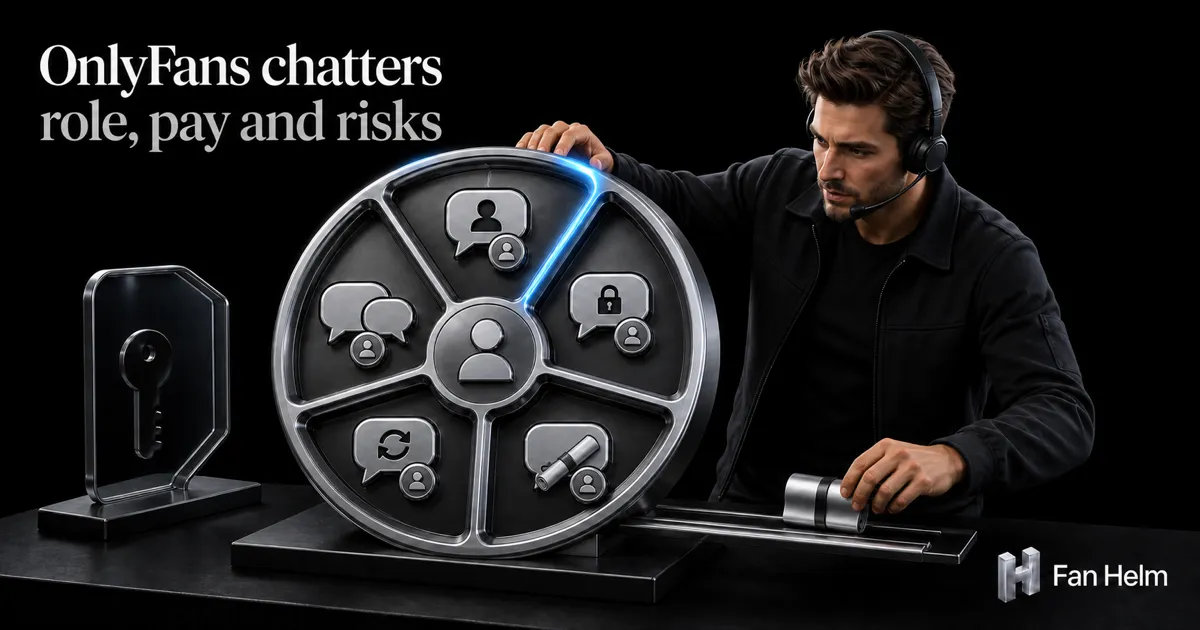
- Welcome new subscribersThe first exchange sets whether a new subscriber becomes a spender or churns at the end of the month. Most accounts run a deliberate opening sequence rather than improvising it.
- Build and hold rapportRemembering what a fan told you three weeks ago is the whole job. Fans spend with the people who remember, and stop when it becomes obvious nobody does.
- Sell pay-per-viewChoosing what to send, to whom, at what price, and when. Sending everyone the same thing at the same price is the beginner error that suppresses an account's revenue permanently.
- Re-engage lapsed fansWorking the list of people who used to spend and stopped. Unglamorous, and usually the highest-return hour of any shift.
- Hand over cleanlyLeaving notes so the next shift does not restart every conversation from zero. Where handover is weak, fans notice immediately.
How chatters are paid
| Structure | How it works | Trade-off |
|---|---|---|
| Hourly | A flat rate per shift regardless of sales. | Predictable for both sides; weak link to performance, so it needs measurement to stay honest. |
| Commission | A percentage of what the chatter sells on shift. | Strong incentive, but pushes hard selling and can burn a fan base if nothing tracks repeat spend. |
| Hourly plus commission | A floor rate with a performance component. | The most common arrangement on established teams, and the most stable. |
Rates vary widely by region and by whether the chatter is hired directly or through an outsourcing firm. Circulating figures are largely unsourced; treat specific numbers as unverified unless cited.
Commission only works if the attribution is real. If nobody can say which chatter sent which message, commission becomes an argument every month and the best performers leave first.
The risk the role creates
A chatter has direct access to the account's most valuable relationships while typically having the least stake in the business. That combination produces a small number of predictable failure modes, and pretending otherwise is how agencies get hurt.
- Taking a fan off-platform. A chatter moves a high-spending fan to a private arrangement — a different platform, a personal account — and the revenue simply disappears. This is the expensive one and it is usually discovered months late.
- Quiet under-performance. Not theft, just a shift that consistently earns less. Invisible without per-chatter numbers, and costs more in aggregate than theft does.
- Over-promising. Committing the creator to content that does not exist, or to a meeting that will never happen, to close a sale. The refund and the reputational damage land on the account.
- Policy exposure. Saying things that breach OnlyFans' rules, or using automation to keep up with volume. The ban risk sits with the creator's account.
- Fan-list exposure. A chatter who can see a fan's handle or profile link has everything needed to find them independently.
Why chatters should not see the fan's OnlyFans handle
There is no operational reason a chatter needs a fan's @handle or profile link to do the job — display name and conversation history are sufficient. There is a clear reason to withhold it: the handle is the mechanism by which a relationship gets taken off-platform. FanHelm shows managers and owners the handle and shows chatters the display name only, deliberately.
Managing a chat team well
- Measure per person, from the start. Not as surveillance theatre, but because coaching without numbers is guesswork and the good chatters want their work to be visible.
- Staff the earning hours before chasing 24/7 coverage. Full-clock coverage on an account with a concentrated timezone is expensive and rarely pays for itself.
- Give the chatter the fan's spend history. A chatter who can see that this fan has spent four figures behaves differently — and correctly — from one seeing an undifferentiated inbox.
- Write the scripts as a floor. Shared openers and objection handling lift the weakest performance; the strongest chatters will and should deviate.
- Make handover a documented step rather than a habit. Notes on the fan, not in a chatter's head.
- Keep an audit trail nobody can edit. It protects the honest chatters as much as it catches the others — when a creator queries what was said, the record answers instead of a manager's memory.
If you are looking for chatter work
The role is remote, shift-based and hired almost entirely on demonstrated conversion rather than credentials. A few things are worth knowing before you take a position.
- Ask how you are measured and how you will see your own numbers. An agency that cannot show you your performance cannot pay you fairly on it either.
- Confirm the pay structure in writing, including what happens to commission on a refunded or charged-back sale.
- Expect to work someone else's voice. If a job asks you to present yourself as the creator in ways that would mislead a fan about who they are meeting, that is a risk you are carrying too.
- Be wary of any role requiring you to pay for training or software up front.
- Understand that automation tools which send on your behalf put the creator's account at risk, and that being asked to use them is a signal about the operation you are joining.
Common questions
- What is an OnlyFans chatter?
- Someone hired to answer a creator's direct messages and sell pay-per-view content on their behalf, usually working a defined shift as part of a rota. Most of a managed account's revenue is generated in that inbox.
- How much do OnlyFans chatters make?
- It varies widely by region and by whether the arrangement is hourly, commission, or a mix. Specific figures circulating online are largely unsourced recruitment marketing, so treat them as unverified unless they carry a citation.
- Is chatting on OnlyFans legal?
- Yes, as employment. What creates exposure is misrepresenting who a fan is talking to in a way that misleads them about what they are buying, and using automated sending, which breaches OnlyFans' policy and puts the creator's account at risk.
- Do fans know they are talking to a chatter?
- Often not, and this is the ethically contested part of the model. Practices differ across agencies; the defensible line most operators draw is that a chatter may speak in the creator's voice but must not promise things the creator will not deliver.
- How do agencies stop chatters stealing fans?
- Primarily by limiting what a chatter can see — no fan handle or profile link — and by keeping a message record with an author against every line, so a pattern is visible early rather than discovered after the revenue has gone. Contractual terms help but do not detect anything.
Bring the month that still bothers you.
Thirty minutes, your real numbers. We'll walk a month back through FanHelm and show you what it would have caught. If your current setup would have caught all of it, we'll say so.
Related reading
 Chatter management softwareWhat software for managing OnlyFans chat teams should do — per-chatter attribution, fan spend in conversation, and an audit trail that holds up.
 What OnlyFans management actually involvesThe operational reality of managing an OnlyFans account — the daily message load, chatter oversight, pricing and payout maths, and where each breaks.
 The OnlyFans manager roleWhat an OnlyFans manager does, how the role is paid, and what separates a good one — whether you are hiring one or becoming one.
 OnlyFans agencies, explained without the pitchWhat OnlyFans agencies actually do, typical revenue splits, the contract terms worth arguing over, and how to tell a real operation from a bad one.
 OnlyFans agency softwareHow to evaluate OnlyFans agency software and OFM CRMs — the capabilities that matter, the pricing models that punish growth, and the risk in autopilot.