
OnlyFans agency software
OnlyFans agency software — variously sold as an OFM CRM, a creator management platform or agency management software — exists to do one thing: let a team run several creator accounts without opening several browsers. What separates the products is not the feature list. It is what they charge as you grow, and how much risk they put on the creator's account.
Last reviewed
What this category is for
OnlyFans does not provide a multi-account view. A creator logs into their own account, and that is the whole model. Every agency therefore hits the same wall the moment it manages a second creator: two accounts, two logins, two inboxes, no way to see the business as a whole.
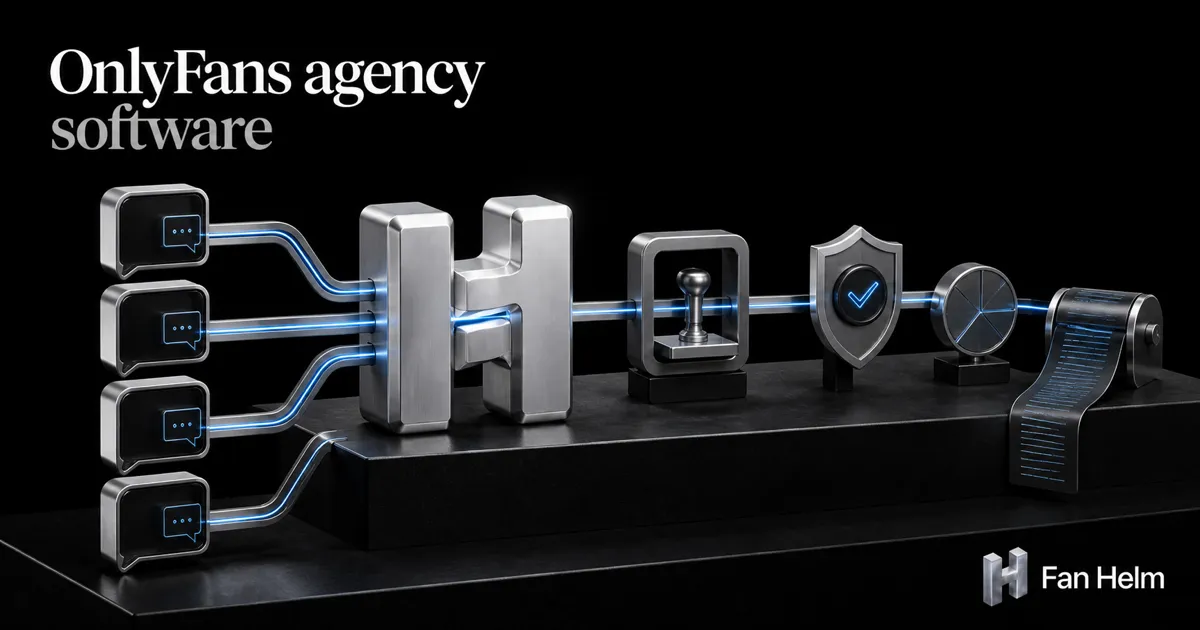
Agency software fills that gap. The good implementations give a team one operational view across every creator, with the context needed to act — what this fan has spent, who last spoke to them, what they have already bought — visible at the point of the conversation rather than three clicks away.
The capabilities that actually matter
Most vendors list forty features. In practice six of them decide whether the software changes how the business runs.
- One inbox across every creatorThe whole roster in a single window, with conversations sortable by value rather than by recency. Everything else in the category is downstream of this working properly.
- Fan spend at the point of conversationA chatter should see what this fan has spent — lifetime, recently, on what — before writing the reply. Without it, a four-figure fan and a four-dollar fan look identical, and get treated identically.
- Per-chatter attributionAn author recorded against every message and every sale. This is what makes commission calculable, coaching possible and off-platform poaching detectable. Software that cannot say who sent a message cannot support a team.
- Splits and payouts computed, not retypedCreator split, chatter commission, platform fee and chargeback holds calculated from the source figures. The monthly payout argument is almost always a symptom of a spreadsheet, not of bad faith.
- An audit trail that cannot be editedWho did what, when, in a record nobody can retrospectively adjust. It protects the honest people on the team as much as it catches anyone else.
- Analytics that answer commercial questionsNot dashboards for their own sake — which traffic source produced spenders rather than subscribers, which price point converted, which chatter's shifts earn.
The pricing model matters more than the price
This category has an unusual convention: several vendors band their price to what each creator earns, so the invoice rises when an account has a good month. It is worth understanding before you compare headline numbers.
| Model | How it behaves | Who it suits |
|---|---|---|
| Earnings-banded per creator | Price per creator profile scales with that creator's monthly earnings. Growing an account increases the software bill. | Vendors. It is a share of your upside dressed as a subscription. |
| Flat per creator | The same price whether a creator earns $500 or $50,000 a month. | Operators whose whole business is making accounts earn more. |
| Per seat | Priced by how many chatters and managers you have. | Rarely a good fit here — it taxes shift coverage, which is the thing you want more of. |
Infloww publishes an earnings-based calculator starting at $40 per creator profile per month, with the price rising by the creator's monthly earnings band (infloww.com/pricing, checked 24 July 2026). Third-party reports place the upper bands substantially higher, but Infloww does not render those figures publicly, so treat any specific ceiling as unverified.
FanHelm's position on this
FanHelm charges a flat rate per creator — indicatively $249/month for up to three creators and $749/month for up to fifteen, confirmed on the call — with unlimited seats on every plan. A creator's record month changes your margin, not your invoice. Seats are free because shift coverage is the thing that makes an account earn, and charging for it is charging you for doing the job well.
The automation question
Several products in this category sell autonomous AI chat — software that replies to fans and sends without a person involved. It is the single most important thing to be clear-eyed about when choosing a vendor.
Fully automated messaging is against OnlyFans' policy. The consequence of enforcement does not land on the software vendor; it lands on the creator's account, which is the entire business. A vendor selling autopilot is selling you a service whose downside sits on your client's balance sheet rather than theirs.
There is a workable line, and it is not the same as refusing to use AI. Software can draft, prioritise, translate, summarise a fan's history and surface who is worth a reply — and then require a person to approve what actually goes out. FanHelm is built on that side of the line: nothing sends without human approval, deliberately, as a product constraint rather than a setting.
How to evaluate a vendor
- Ask what the price becomes when a creator triples their earnings. If the answer is a band table, you are buying a revenue share.
- Ask to see a chatter's message history for a single day, in the product, on a real account.
- Ask how a payout is calculated and whether the working can be shown to a creator who disputes it.
- Ask whether anything sends without a human pressing something. Then ask who carries the ban risk if it does.
- Ask what a chatter can see about a fan — specifically, whether they can see the fan's OnlyFans handle or profile link.
- Ask what happens to your data if you leave. The fan list, spend history and message archive are your assets.
- Ask what it takes to add creator number sixteen — technically and commercially.
Where FanHelm fits
FanHelm is an operating system for OnlyFans agencies rather than a chat tool with reporting attached. The whole roster runs in one inbox; every fan's spend is on screen next to the conversation; every message carries the name of who sent it; splits, chargeback holds and chatter commission are computed before anyone has to argue about them; and the audit log cannot be rewritten after the fact.
Two constraints are deliberate and will not change. Nothing sends without a person approving it. And chatters do not see a fan's OnlyFans handle — managers and owners do — because that link is the mechanism by which a relationship gets taken off-platform.
Figures shown in product screenshots across this site are demo data, labelled as such. We would rather show you the real thing on your own numbers.
Common questions
- What is an OnlyFans CRM?
- A customer-relationship system adapted to creator accounts: one place to see every fan across every creator you manage, with their spend, purchase history and conversation attached. In this market the terms 'OnlyFans CRM', 'OFM software' and 'agency management platform' are used interchangeably for the same category.
- Is OnlyFans agency software against OnlyFans' terms?
- The category is not prohibited, and OnlyFans accommodates managers and shared account access. What breaches policy is fully automated sending. The practical distinction is whether the software assists a person or replaces them at the point a message goes out — and which of you carries the consequence if the account is actioned.
- How much does OnlyFans agency software cost?
- It depends heavily on the pricing model. Several vendors charge per creator profile with the rate banded to that creator's earnings, starting around $40/month and rising with performance. FanHelm charges flat per creator — indicatively $249/month up to three creators and $749/month up to fifteen, with unlimited seats — so growth does not increase the bill.
- Do I need agency software for one creator?
- Usually not. One account can be run directly. The case for software starts at the second or third creator, when context-switching between accounts begins costing more time than the tooling would, and becomes acute once other people are working the inbox on your behalf.
- Can this software send messages automatically?
- FanHelm will not. It drafts, prioritises and surfaces who is worth replying to, but a person approves every send. Some competitors do offer autonomous sending; that capability breaches OnlyFans' policy, and the enforcement risk sits with the creator's account rather than the vendor's.
Sources
Bring the month that still bothers you.
Thirty minutes, your real numbers. We'll walk a month back through FanHelm and show you what it would have caught. If your current setup would have caught all of it, we'll say so.
Related reading
 The 30-minute OnlyFans agency auditA concrete 30-minute weekly OnlyFans agency audit for access, chats, PPV, money, commission, vault content and human approvals.
 OnlyFans CRM migration checklistThe OnlyFans CRM migration checklist: inventory fans, messages, vault media, permissions, rates and audit history before switching tools.
 Chatter management softwareWhat software for managing OnlyFans chat teams should do — per-chatter attribution, fan spend in conversation, and an audit trail that holds up.
 OnlyFans analyticsWhich OnlyFans metrics change decisions, what the platform's own statistics leave out, and how to measure fan value and chatter performance.
 OnlyFans agency payouts and revenue splitsHow OnlyFans agency payouts are really calculated — platform fee, creator split, chatter commission and chargeback holds — and why they drift.