OnlyFans agency payouts and revenue splits
A payout looks simple until three parties have a claim on the same dollar. Between OnlyFans' platform fee, the creator's split, the chatter's commission and a chargeback that lands three weeks later, the number everyone agreed on rarely survives contact with the month. Most agency-creator relationships that end badly end here.
Last reviewed
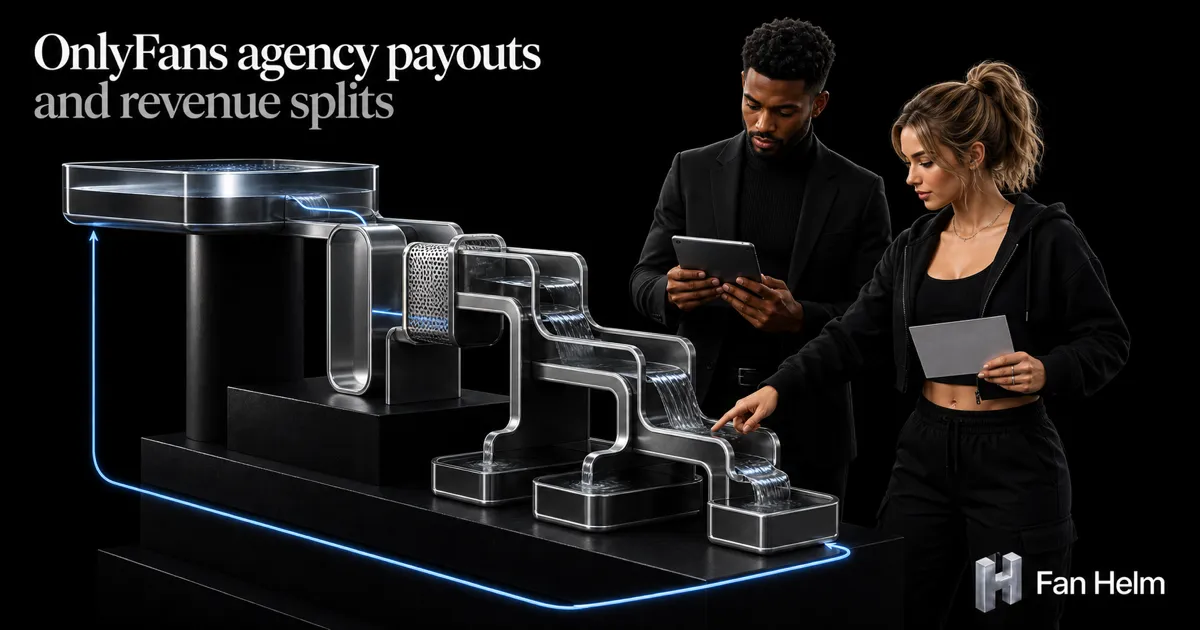
The order the money moves in
Getting the sequence right is most of the battle, because a percentage means completely different things depending on where it sits in the stack.
- Gross earningsEverything a fan pays — subscriptions, pay-per-view, tips, custom content. This is the number people quote and the least useful one.
- OnlyFans' platform feeThe platform takes 20% of gross before anything reaches the creator's balance. Nothing downstream can be calculated from gross without accounting for it first.
- The creator's netWhat actually arrives — roughly 80% of gross. Every split you have agreed should be defined against a clearly named base, and this is usually the honest one.
- The agency splitThe agency's percentage. The critical question is whether it is taken from gross or from net, because a '40% split' means two materially different numbers depending on the answer.
- Chatter commissionUsually taken from the agency's share rather than the creator's. If it is calculated from a different base than the creator split, the two will eventually disagree in public.
- Chargeback holds and adjustmentsRefunds and chargebacks arrive after the payout has already been made. Whoever absorbs them should be defined in advance, in writing.
The one clause to get right
Write down whether the agency percentage applies to gross earnings or to the creator's net after OnlyFans' 20%. A 40% split on gross leaves the creator 40% of gross; a 40% split on net leaves them 48%. That eight-point gap is a real amount of money and it is the single most common source of payout arguments in this industry.
Why the arithmetic drifts
Almost nobody sets out to miscalculate a payout. It happens because the figures move after they are copied.
| Cause | What goes wrong | The fix |
|---|---|---|
| Copied into a spreadsheet | The month's numbers are transcribed on the 1st and then a late refund changes them on the 5th. The sheet is now wrong and nobody knows. | Compute from the source data at the moment of payout, not from a snapshot. |
| Chargebacks land late | Commission has already been paid on a sale that reversed. | Hold a defined portion against chargebacks and settle after the window. |
| Different bases | The creator split is computed on net, the chatter commission on gross. The two never reconcile. | One base, named in both agreements. |
| Manual adjustments with no record | Someone corrects a figure and nobody can later say why. | Adjustments as recorded entries with a reason, not edits. |
| Tips and customs handled ad hoc | Off-platform or one-off payments get counted inconsistently month to month. | Decide the treatment once and apply it automatically. |
Payout timing
OnlyFans holds earnings for a period before they become withdrawable, and pays on its own schedule. An agency sitting between the platform and the creator inherits that timing whether it wants to or not.
- Do not promise a creator a payout date earlier than the platform's own release. You will miss it, and it will be read as something worse than a timing issue.
- Decide whether you pay creators on receipt or on a fixed date, and hold to it. Predictability is worth more to a creator than speed.
- Keep the chargeback window in mind when setting that date — paying out fully before the window closes means clawing money back later, which is far more damaging than a slightly later payment.
- Pay chatters on a schedule that survives a bad month. Commission-only pay with no floor makes your team's income a function of your account mix.
What a creator should be able to see
The test of a payout process is not whether it is correct. It is whether it can be shown to be correct by someone who is annoyed.
- Gross earnings for the period, broken down by type.
- The platform fee deducted, stated separately rather than folded in.
- The agency percentage, and the base it was applied to.
- Any adjustment, with a reason attached to it.
- Chargebacks and refunds landing in the period, and which earlier period they relate to.
- The resulting figure, reconciling to what actually gets transferred.
If producing that takes an afternoon, it will not be produced when it matters — and the creator will draw their own conclusion about why.
How FanHelm handles it
Splits, chatter commission and chargeback holds are computed from the source figures at the moment of payout rather than transcribed from a snapshot, so a late refund changes the calculation instead of quietly invalidating it. Creator split and chatter commission are computed against the same named base, which is what stops the two disagreeing.
Every adjustment is a recorded entry with a reason rather than an edit, and the log cannot be rewritten afterwards — so the breakdown above is something you can put in front of a creator who is already unhappy, which is the only situation in which it matters.
FanHelm is priced flat per creator rather than as a share of earnings, so it has no claim on the waterfall it is calculating. Figures in product screenshots across this site are demo data, labelled as such.
Common questions
- What percentage does OnlyFans take?
- OnlyFans takes 20% of gross earnings. Everything an agency or chatter is paid comes out of the remaining 80%, which is why it matters enormously whether a quoted agency split is calculated on gross or on the creator's net.
- How is an OnlyFans agency split calculated?
- As a percentage of earnings — but the base varies. Some agencies apply their percentage to gross, others to the creator's net after the platform's 20%. The difference is significant, so the base should be named explicitly in the contract rather than assumed.
- Who pays for a chargeback?
- Whoever the contract says, which is why it needs to say. Chargebacks arrive after a payout has usually been made, so without a defined hold the agency ends up either absorbing them or clawing money back from a creator — and the second is far more damaging to the relationship.
- How is chatter commission usually calculated?
- Most commonly as a percentage of what the chatter sold on shift, taken from the agency's share rather than the creator's. The important detail is that it should use the same base as the creator split; when the two are computed differently, they eventually produce numbers that cannot be reconciled.
- When does OnlyFans pay out?
- Earnings are held for a period before becoming withdrawable, and withdrawal follows the platform's own schedule. An agency cannot pay a creator faster than the platform releases the money, so promising an earlier date is a commitment you will not be able to keep.
Bring the month that still bothers you.
Thirty minutes, your real numbers. We'll walk a month back through FanHelm and show you what it would have caught. If your current setup would have caught all of it, we'll say so.
Related reading
 OnlyFans chatter commission: structures that do not start argumentsBuild an OnlyFans chatter commission plan that survives handovers, refunds and rate changes — with a clear base, attribution rules and history.
 How much do OnlyFans creators make? Gross, net and the numbers nobody can proveThere is no trustworthy public figure for typical OnlyFans earnings. Learn what the official numbers show, what they hide, and what to measure instead.
 OnlyFans agency softwareHow to evaluate OnlyFans agency software and OFM CRMs — the capabilities that matter, the pricing models that punish growth, and the risk in autopilot.
 OnlyFans analyticsWhich OnlyFans metrics change decisions, what the platform's own statistics leave out, and how to measure fan value and chatter performance.
 How to start an OnlyFans agencyWhat starting an OnlyFans agency really takes — signing creators, the split, hiring chatters, the legal setup, and what breaks past five accounts.