
OnlyFans agencies, explained without the pitch
An OnlyFans agency runs the business side of a creator's account — messaging, pricing, promotion and scheduling — in exchange for a cut of earnings, usually somewhere between 20% and 50%. That is the whole model. Everything else is a question of who does the work, who sees the money, and what happens when the relationship ends.
Last reviewed
What an agency actually does
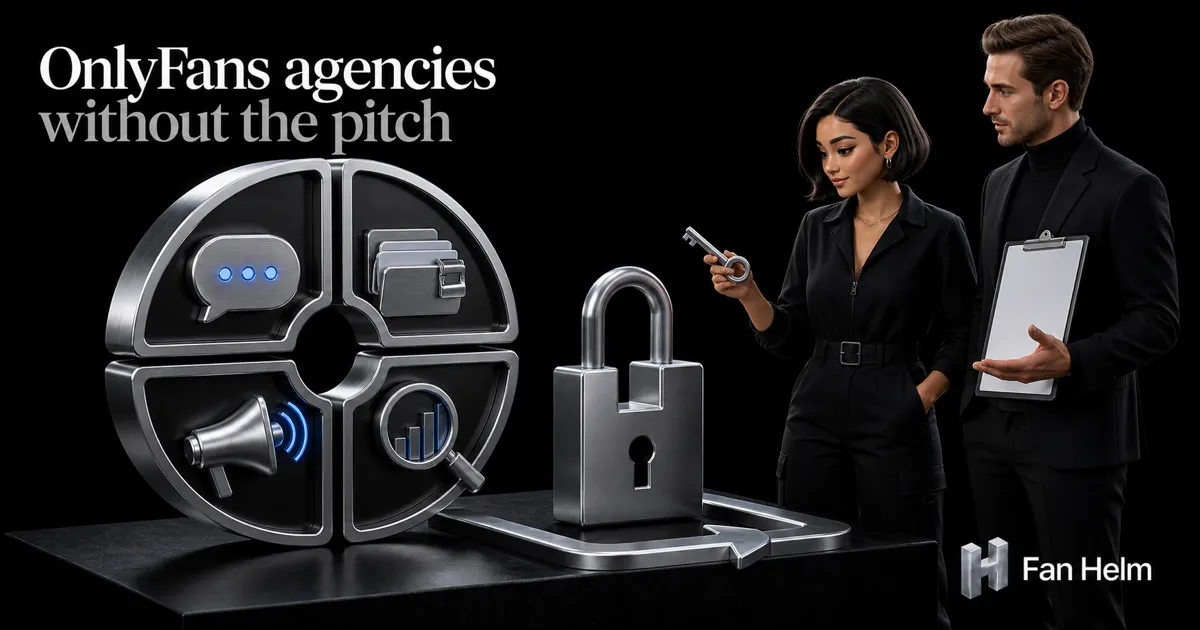
Strip away the branding and almost every agency sells the same four things. How well it does them is the only real variable.
- Messaging and salesChatters answer DMs, build rapport and sell pay-per-view content. This is where most of the money is made, and it is by far the largest line of labour an agency provides. A busy account can take thousands of messages a day across a rotating shift pattern.
- Content operationsSorting, tagging and scheduling what the creator shoots — so the right clip goes to the right fan at the right price, and nothing gets sent twice to someone who already paid for it.
- PromotionDriving traffic from Reddit, X, TikTok, Instagram and paid placements to the subscription page. Some agencies are genuinely good at this; many quietly do very little of it and rely on the creator's existing audience.
- Analytics and pricingDeciding what to charge for a subscription, what to charge for PPV, which fans are worth chasing and which campaigns paid for themselves. The competent agencies treat this as a discipline. The rest guess.
What an agency does not do is change the platform. OnlyFans owns the payment rail, the payout schedule and the rules. An agency that promises to bypass any of that is describing a policy violation, not a service.
What agencies charge
Agencies are paid as a percentage of gross earnings, taken after OnlyFans' own 20% platform fee. The range is wide and it correlates loosely with how much of the work the agency actually absorbs.
| Typical split | What it usually buys | Watch for |
|---|---|---|
| 10–20% | Chatting only, often on one shift pattern, with the creator handling content and promotion. | Whether the coverage is genuinely 24/7 or three chatters covering the profitable hours. |
| 30–40% | Chatting, content scheduling and some promotion. The common mid-market band. | Whether promotion means paid traffic and Reddit work, or just reposting the creator's own content. |
| 50%+ | Full management: chatting, content direction, paid traffic, sometimes production costs. | At this level the agency should be spending real money on growth. Ask what it spends and on what. |
Splits are taken on top of OnlyFans' 20% platform cut, so a 50% agency split leaves the creator roughly 40% of gross. Confirm which side of the platform fee a quoted percentage sits on before signing anything.
The number that matters is not the percentage
A 20% agency that adds nothing is more expensive than a 40% agency that doubles the account. Judge the split against the growth it is supposed to produce, and insist that growth is measured against the account's own trajectory before the agency arrived — not against a hypothetical.
Contract terms worth arguing over
Most disputes in this industry are not about the split. They are about who controls the account and what happens when someone wants out.
- Account ownership. The OnlyFans account, its email and its payout details should be the creator's, always. An agency holding the login is holding the business hostage.
- Exit terms. How much notice, and what happens to earnings already in flight? A 30-day exit with a clean handover is normal; a 12-month lock with a termination fee is not.
- Exclusivity. Does the agency claim a cut of income it did not generate — brand deals, other platforms, merchandise? Scope the split to the accounts it actually works.
- Post-termination tail. Some contracts claim a percentage of the account's earnings for months after the relationship ends. Read for it specifically; it is easy to miss and expensive to discover late.
- Sub-processing. Does the agency subcontract chatting to another firm? If so, the creator's DMs are being read by a company they never agreed to.
- Data on exit. The fan list, the spend history and the message archive are the account's real assets. Agree in writing that they come back with the creator.
How to tell a real operation from a bad one
The industry has a low barrier to entry, so the spread in quality is enormous. These questions are uncomfortable to answer badly, which is exactly why they work.
- "Who will actually be in my DMs, and where are they?" A named team on a documented shift rota is a different proposition from an anonymous pool.
- "Show me a chatter's message history for one day." A serious agency can produce this in seconds. If nobody can say which chatter sent which message, nobody is accountable for what was said.
- "What do you do about a chatter taking a fan off-platform?" Poaching a whale into a private arrangement is the single most costly failure mode in this business. An agency without an answer has not thought about it.
- "How do you calculate my payout?" Ask to see the arithmetic on a real month. If the answer is a spreadsheet only one person understands, expect disputes.
- "What happens if a fan charges back?" Chargebacks land after the split has been paid. Who absorbs it should be written down, not discovered.
- "Do you use automation to send messages?" Fully automated sending on OnlyFans is against platform policy and the ban risk sits with the creator's account, not the agency's software vendor.
Ask for the boring artefact, not the highlight reel
Screenshots of a good month prove nothing — anyone can pick their best week. A shift rota, an audit log and a payout calculation for an ordinary month tell you far more about whether an operation is real.
In-house or agency?
Plenty of creators eventually bring management in-house — hiring their own chatters directly rather than paying a percentage. It is usually cheaper at scale and always more work.
| Agency | In-house | |
|---|---|---|
| Cost shape | Percentage of earnings — scales up as you grow. | Salaries or hourly — fixed, so the margin improves as you grow. |
| Speed to start | Days. The team already exists. | Weeks to months. You are hiring, training and writing the rota. |
| Control | Depends entirely on the contract and the tooling. | Total, provided you have a way to see what your team is doing. |
| Risk | Concentrated in one relationship and one contract. | Concentrated in your own hiring and your own oversight. |
The crossover point is different for everyone, but the tell is usually the same: once the percentage you pay in a month exceeds what the same coverage would cost in salaries, the only thing the agency is still selling you is the management overhead — and that is a thing you can buy software for.
Where FanHelm fits
FanHelm is not an agency and does not take a cut of anyone's earnings. It is the software an agency — or a creator running things in-house — uses to operate: one inbox across every creator, every fan's spend visible next to the conversation, a name against every message sent, and splits calculated before anyone has to argue about them.
It exists because most of the failures above are visibility failures. Nobody can point to the chatter who lost the whale, or the month where the split quietly drifted, because nothing was recorded in a form anyone could check. Pricing is flat per creator rather than scaled to what that creator earns, so growing an account does not increase what the software costs.
Common questions
- Is using an OnlyFans agency against the rules?
- No. OnlyFans permits creators to work with managers and agencies, and its terms accommodate account access being shared. What is not permitted is fully automated messaging and misrepresenting who a fan is talking to. The risk in an agency relationship is contractual and operational, not a question of whether agencies are allowed.
- What is a normal OnlyFans agency split?
- Most sit between 20% and 50% of gross earnings, taken after OnlyFans' own 20% platform fee. Lower splits generally mean chatting only; higher splits should mean the agency is also spending on promotion and content direction. Confirm in writing whether a quoted percentage is calculated before or after the platform fee.
- Can an agency guarantee growth?
- No, and a guarantee is a warning sign rather than a reassurance. Traffic, platform policy and audience behaviour are outside any agency's control. What a good agency can commit to is coverage, response times and a documented way of showing what it did.
- Who owns the account if I leave an agency?
- The creator should, in every case. If the agency created the account, holds the recovery email or controls the payout details, get that changed before signing anything else. Ownership of the fan list and message history should also be written into the contract explicitly.
- How many creators can one agency handle?
- It depends almost entirely on tooling and shift structure rather than headcount. An agency running each creator in a separate browser tab hits a ceiling quickly. One running every account through a single operational view scales considerably further before quality drops — which is why the software question and the capacity question are the same question.
Bring the month that still bothers you.
Thirty minutes, your real numbers. We'll walk a month back through FanHelm and show you what it would have caught. If your current setup would have caught all of it, we'll say so.
Related reading
 What OnlyFans management actually involvesThe operational reality of managing an OnlyFans account — the daily message load, chatter oversight, pricing and payout maths, and where each breaks.
 The OnlyFans manager roleWhat an OnlyFans manager does, how the role is paid, and what separates a good one — whether you are hiring one or becoming one.
 OnlyFans chattersWhat an OnlyFans chatter does, how chatters are paid and measured, and the risks the role creates for an agency that nobody is watching.
 How to start an OnlyFans agencyWhat starting an OnlyFans agency really takes — signing creators, the split, hiring chatters, the legal setup, and what breaks past five accounts.
 OnlyFans agency softwareHow to evaluate OnlyFans agency software and OFM CRMs — the capabilities that matter, the pricing models that punish growth, and the risk in autopilot.